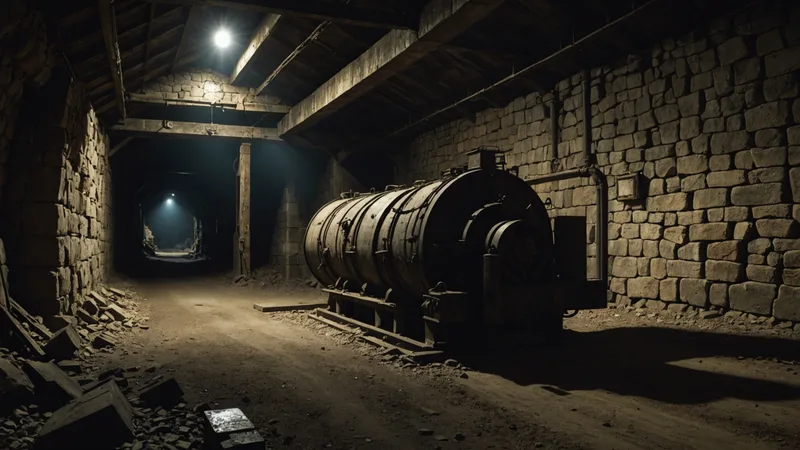
Lab validation and field reality are different things. We knew this before we first deployed in a real underground environment — it's a statement every hardware team repeats as received wisdom. The experience still found specific failure modes we hadn't designed for. These are notes from our testing campaign in a decommissioned hardrock mine in the Nevada desert, framed as "we observed" rather than "we solved." Some of these problems are addressed in the current hardware revision. Others are not.
The mine in question is a former silver-producing operation from the mid-20th century, now partially accessible for research and commercial test purposes under a management agreement. The tunnel network includes approximately 2.4 km of accessible drifts at depths ranging from 8 to 120 meters, with varying geology (decomposed granite at shallow sections, competent quartzite and quartz monzonite at depth), active sumps in the lower workings, and intact ventilation shafts. It represents a reasonable analog for the operational environments we're targeting — not identical, but close enough to stress the hardware in ways that bench testing cannot.
Power: The Constraint That Shapes Everything Else
Underground deployed sensors have no solar. Utility power runs are impractical at tactical deployment speeds. That leaves batteries, and batteries define mission duration, node size, and the entire power budget for sensing, computing, and communication.
We observed in our test deployments that our initial power budget estimates — derived from lab bench measurements of individual components — were systematically optimistic by 15–25%. The discrepancy had several sources. First, RF transmission power in underground environments is higher than in open air. The 915 MHz mesh radio operates at maximum power more frequently underground because signal attenuation is higher, and the duty cycle on active transmission is longer than our bench estimate assumed. Second, temperature affects battery capacity: a lithium-thionyl-chloride cell rated at a nominal capacity delivers approximately 10–12% less capacity at 10°C than at 20°C. The mine's lower workings ran consistently around 14°C, and deeper sections with active water inflow ran closer to 8°C. Third, our geophone amplifier draws slightly higher current than the datasheet nominal value at elevated gain settings — a discrepancy we hadn't caught because our lab testing used a default gain setting that didn't reflect the high-attenuation-substrate operating point.
The practical consequence: nodes we designed for 90-day unattended operation on a primary lithium pack needed servicing at approximately 68–72 days in the mine environment. For a tunnel sensor deployment where node access may be operationally complicated, that's a meaningful gap. We've revised the power budget model with empirical correction factors, and the current hardware revision includes a larger primary cell. We have not completed the 90-day validation of the revised design.
Moisture Ingress: Where IP65 Is Not the Ceiling
IP65 means protected against dust and against low-pressure water jets from any direction. In tunnel environments, the relevant threats are different: condensation cycling, drip from overhead rock fractures, and temporary immersion in standing water from drainage interruption. IP65 does not cover submersion; IP67 (30-minute immersion to 1 meter) and IP68 (continuous submersion) are the relevant thresholds for environments with flooding risk.
We observed two distinct moisture failure modes during testing. The first was gasket compression set: the silicone gaskets sealing our node enclosure were compressed when the unit was closed at room temperature in our California workshop. When the enclosure temperature dropped to mine ambient and then cycled back up with body heat during handling, the gaskets lost some compression, and over repeated cycles the seal degraded. The fix is using higher-durometer gasket material rated for a wider temperature range, which we implemented mid-campaign.
The second failure mode was more subtle: moisture vapor transmission through the enclosure walls. At the humidity differentials we measured in the mine (relative humidity in the lower workings exceeded 95% on drip days, versus the 40–50% RH at which the enclosures were sealed in the shop), water vapor permeated through the enclosure walls and condensed on the PCB. The amount of moisture was not detectable by mass measurement, but it was enough to cause intermittent contact failures on the geophone connection header. The solution is desiccant inside the enclosure — obvious in retrospect, implemented in the next revision. The lesson we took: IP65/67 ratings address liquid water ingress, not vapor transmission over extended time periods. They're necessary but not sufficient for the humidity levels we're operating in.
Temperature Cycling: 0–45°C and What That Does to Electronics
The mine's temperature range across tested sections was approximately 8–22°C, which is well within standard industrial electronics operating range. But that's not the full thermal load the hardware experiences. Nodes transported from a vehicle in direct Nevada desert sun to an underground environment can enter at 45°C external temperature and stabilize to 14°C over several hours. The thermal cycling from surface handling to deployment to periodic retrieval creates mechanical stress on solder joints and component mounting.
We observed one PCB trace fracture over approximately 40 thermal cycles at our test node. Post-analysis suggested the fracture initiated at a large thermal mass component (the main processor IC) where the coefficient of thermal expansion mismatch with the FR4 substrate is highest. This is a known failure mode in automotive and aerospace electronics that gets addressed with flex-region routing and underfill. Our current PCB layout does not include those mitigations; it's on the revision list.
We're not saying 0–45°C cycling is an unusual requirement — most industrial components are rated to that range and beyond. We're saying that the combination of rapid cycling and confined geometry in a compact enclosure produces thermal gradients across the board that create mechanical stress in excess of what steady-state temperature specs capture. The delta-T matters more than the absolute temperature in this failure mode.
Explosive Atmospheres and the ATEX Question
The decommissioned mine we tested in does not have active explosive atmospheres — no methane, no coal dust, no active explosives storage. But the border tunnels and military underground environments that represent our target operational context may. The ATEX (Atmosphères Explosibles) directive in Europe, and the equivalent NEC 505/506 in the US, define requirements for electrical equipment used in potentially explosive atmospheres. Zone classification (Zone 0, 1, 2 for gases; Zone 20, 21, 22 for dusts) determines the equipment category required.
Our current hardware is not ATEX-classified. We do not claim otherwise. For operational environments where explosive atmosphere risk exists — tunnels used to transport or store explosive materials, legacy mine workings with residual gas pockets, or coal mine adjacencies — our hardware would require ATEX-classified variants before deployment. Achieving ATEX certification for a compact autonomous node is a significant engineering undertaking; it affects battery chemistry, enclosure design, contact materials, and PCB conformal coating approaches. We're aware of this gap. Procurement discussions that include potentially explosive environments should flag this requirement explicitly.
Cable Routing in Confined Spaces
Our sensor nodes are designed for wireless mesh networking, but power cabling for extended deployments (when primary battery swap is operationally impractical) requires physical cable runs. Running cable through working mine drifts and tunnel corridors introduces problems that don't show up in architectural drawings: cable crush at corner junctions, abrasion against irregular rock surfaces, water accumulation in cable conduit acting as a corrosion path, and the practical problem that cable routing in a rough tunnel requires two-person operations in tight spaces.
We observed that conduit-protected runs degraded faster than expected at corner bends where the conduit was compressed against rock. We also observed that split-loom cable protection — adequate for organized wire runs in equipment rooms — is not adequate for repeated contact with rock surfaces. The correct solution for rough rock surfaces is armored conduit with metallic braid or steel tape, which is also significantly heavier and harder to deploy at speed. The cable routing question is one where the operational simplicity of wireless-only deployment has real value: it's not just convenience, it's a reduction in a significant class of physical failure modes.
What the Lab Doesn't Capture
The category we found most instructive was not the individual failure modes but the combination effects. IP65 enclosures plus thermal cycling plus mine humidity plus vibration from blasting in adjacent sections (the mine conducts occasional controlled blast events in non-accessible areas) produced effects that didn't appear in any individual lab qualification test. Environmental qualification tests tend to be serial: temperature cycling, then vibration, then humidity — not simultaneous or in realistic sequence.
For hardware designed to operate unattended in underground environments for 60-90 day intervals, the relevant qualification sequence is more demanding than standard military spec MIL-STD-810 for most individual test methods. We're not positioned to claim MIL-STD-810 qualification status. What we can say is that the failure modes we observed in field testing are being systematically addressed in hardware revisions, and the current prototype revision performed substantially better on repeat deployment than the first version. Field testing remains an ongoing part of our development cycle, not a one-time qualification event.